
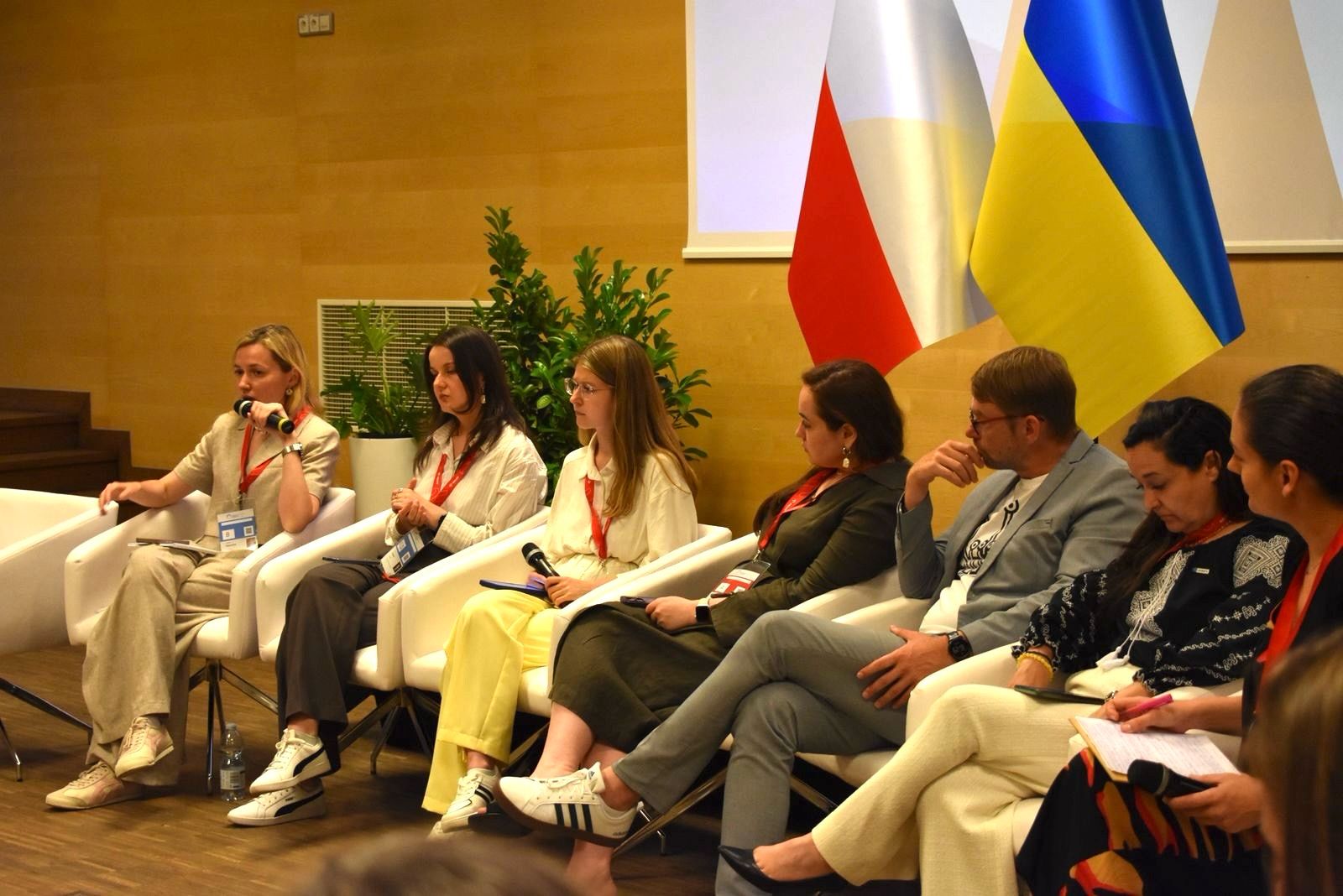
Liubov Rakovytsia, Chair of DII-Ukraine and Head of the Donbas Media Forum (DMF) Organising Committee, took part in the roundtable discussion “Ukrainian Media and Information Resilience” during the Ukraine Recovery Conference 2026 in Gdańsk. For the first time in the conference’s history, the topic of independent media was included in the official main programme rather than being held as a side event.
The discussion brought together representatives of the Ukrainian government, international organisations, and the media community to examine the role of journalism in Ukraine’s recovery, strengthening public trust, and advancing European integration.
Other participants included Nataliia Movshovych, Deputy Minister of Culture of Ukraine for European Integration; Thibaut Bruttin, Director General of Reporters Without Borders (RSF); Chiara Dezzi Bardeschi, Head of the UNESCO Office in Ukraine; Taavi Linnamäe, Communications Director of Ukraine Recovery Conference 2027 (Estonia); Anastasiia Rudenko, Head of the Recovery Window network; and Hanna Chabarai, Head of Communications and Deputy Director of the Institute of Mass Information (IMI).
‘It is incredibly important to me that this year, the issue of media was included in the main programme of the Ukraine Recovery Conference for the very first time. Finally, there was a panel dedicated specifically to media—not as an additional side event, but as part of the central conversation about Ukraine’s recovery. This shows that our international partners increasingly recognise that without independent media, it is impossible to build trust, and without trust, recovery itself cannot succeed,’ said Liubov Rakovytsia.
She opened her remarks with a statement that became one of the most powerful moments of the panel and was met with applause from the audience.
‘The expectations placed on the media are enormous. We are expected to explain reconstruction, monitor public spending, counter disinformation, support local communities, preserve public trust, communicate with people living near the frontline, and maintain connections with those who remain under occupation. Yet many Ukrainian newsrooms—and I say this as someone who comes from regional media myself—are exhausted, displaced, underfunded, working under shelling, facing psychological pressure, staff shortages, and constant uncertainty. That is why media are not external observers of Ukraine’s recovery. They are part of the recovery infrastructure.’
During her speech, Rakovytsia also highlighted the key challenges facing Ukrainian newsrooms today, including the need to preserve editorial independence while implementing donor-funded projects, restricted access to information due to security considerations, and the growing difficulty of reaching audiences, particularly in temporarily occupied territories.
She also presented the results of the International Fund for the Reconstruction of Ukrainian Media (IFRUM), a project administered jointly by DII-Ukraine and Lviv Media Forum.
The International Fund for the Reconstruction of Ukrainian Media (IFRUM) is a politically independent fund launched in September 2025 by Reporters Without Borders (RSF) together with leading Ukrainian media freedom organisations, including the Institute of Mass Information (IMI), Lviv Media Forum, Detector Media, DII-Ukraine, Recovery Window, and the Media Development Foundation (MDF).
The fund’s first grant competition received 226 applications, with an independent expert committee selecting 22 media outlets for support. According to Rakovytsia, the fund’s primary objective is not to make media organisations dependent on donor funding, but to create conditions for their financial, institutional, and editorial independence.
Concluding her remarks, she called on international partners to invest not only in content production but also in the long-term sustainability of Ukrainian newsrooms.
‘If we expect the media to oversee Ukraine’s recovery, we must also invest in the recovery of the media themselves—in their teams, systems, business models, technologies, and security. Independent regional media are not an addition to the recovery process. They are one of the essential conditions for ensuring that people trust that recovery.’