
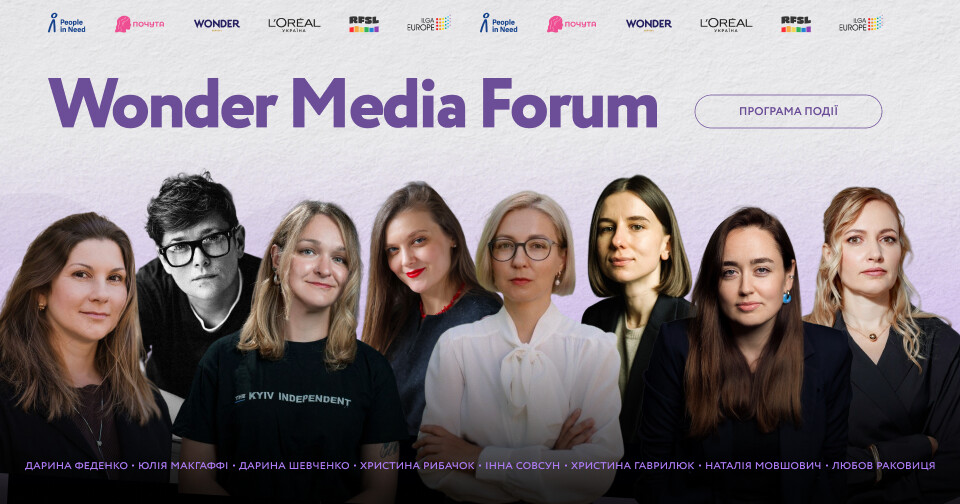
How can media help make the European integration process understandable for people, and why should human rights remain at the center of public policy even during wartime? These questions became central to the public day of Wonder Media Forum 2026, held in Kyiv on June 5.
The event brought together representatives of media, civil society, international organizations, and public institutions to discuss media, human rights, feminism, and issues affecting the LGBTQI+ community.
Liubov Rakovytsia, Head of DII-Ukraine and Chair of the Organizing Committee of Donbas Media Forum, took part in a panel discussion on the role of public policy in advancing human rights and Ukraine’s European integration.
Joining her on the panel were Member of Parliament of Ukraine Inna Sovsun, Coordinator for Support to Independent Media and Gender Equality at the Embassy of Sweden in Ukraine Khrystyna Rybachok, and Deputy Minister of Culture for European Integration Nataliia Movshovych. The discussion was moderated by advocacy specialist and Editor-in-Chief of Wonder Media, Iolanta Trots.
During the discussion, participants emphasized that European integration is not only a process of legislative harmonization but also a matter of values, communication, and the state’s ability to explain change to people.
Liubov Rakovytsia highlighted the special role of media in this process — especially for residents of smaller communities and regions.
“The role of media is to bring the topic of European integration to audiences — a large and complex process that often consists of directives, decisions, and legislation that can be difficult for people to understand. We have already seen situations where reforms were difficult to accept precisely in the places where they were being implemented. That is why journalists need to understand what is happening, explain it in accessible language, and speak not only about the benefits but also about difficult questions and the consequences of change. These questions need answers rather than avoidance — and this is exactly where the role of media becomes crucial,” Rakovytsia noted.
At DII-Ukraine, we believe that quality journalism and strong local media remain among the key instruments for making complex public processes understandable to people and ensuring that societal change is felt not only at the policy level but also in everyday life.