
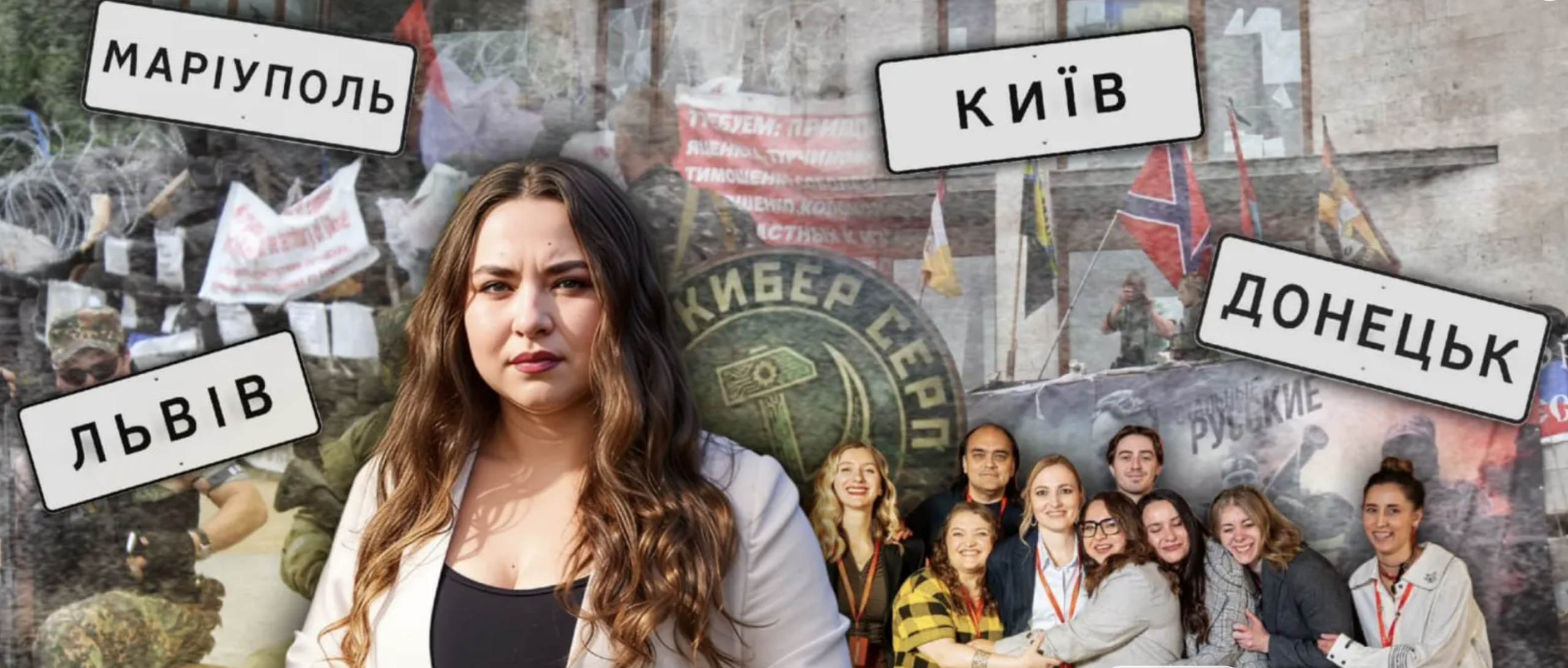
The editorial team of Novyny Donbasu has been forced to relocate twice because of Russian aggression: from Donetsk in 2014 and from Mariupol in 2022. Despite losing their homes, facing staffing challenges, the mobilization of some team members, and Russian cyberattacks, the outlet continues to report on life in temporarily occupied and frontline territories and counter Russian propaganda.
In a new article for Zmina.Info, journalist Yurii Lukanov tells the story of the newsroom and its editor-in-chief, Yuliia Didenko — from their work in Donetsk on the eve of the occupation and their first relocation to their departure from Mariupol just one day before the full-scale invasion began. After February 24, 2022, the newsroom did not stop working. By early March, the team had launched a daily digest covering developments in occupied and frontline territories and maintained contact with people managing to escape Mariupol.
A separate part of the article explores how the work of Novyny Donbasu has changed since the full-scale invasion. Today, one of the newsroom’s key areas of focus remains reporting on life in the temporarily occupied territories. In particular, its journalists investigated the mechanism used to seize housing in Mariupol and found that the occupation authorities had listed at least 25,000 properties as so-called “ownerless” real estate.
The team also systematically investigates Russian propaganda in the occupied territories and became one of the driving forces behind the creation of DII-Ukraine’s Relocated Media Cluster, which has brought together around 15 newsrooms forced to leave their home regions because of the war. Within the Cluster, media outlets collaborate on complex topics, dividing the production of articles, videos, and social media content among participating newsrooms.
In spring 2026, Novyny Donbasu faced another major challenge: a large-scale Russian cyberattack that temporarily took its website offline, while hackers deleted its archive database. The newsroom continued publishing, shifting its work to social media and Substack while simultaneously developing a new, more secure website.
Following the attack, one of the most important signals for the team was the response from readers, including those who remain under occupation. They searched for the newsroom on social media and wrote to ask when the website would be back online.
“One man wrote: ‘I’ve been reading you since Donetsk.’ At moments like this, you realize that everything we do is not in vain,” says Yuliia Didenko.
Read the full story of Novyny Donbasu’s two relocations, its work with audiences under occupation, investigative journalism, efforts to counter propaganda, and the newsroom’s recovery after the cyberattack in Yurii Lukanov’s new article.