
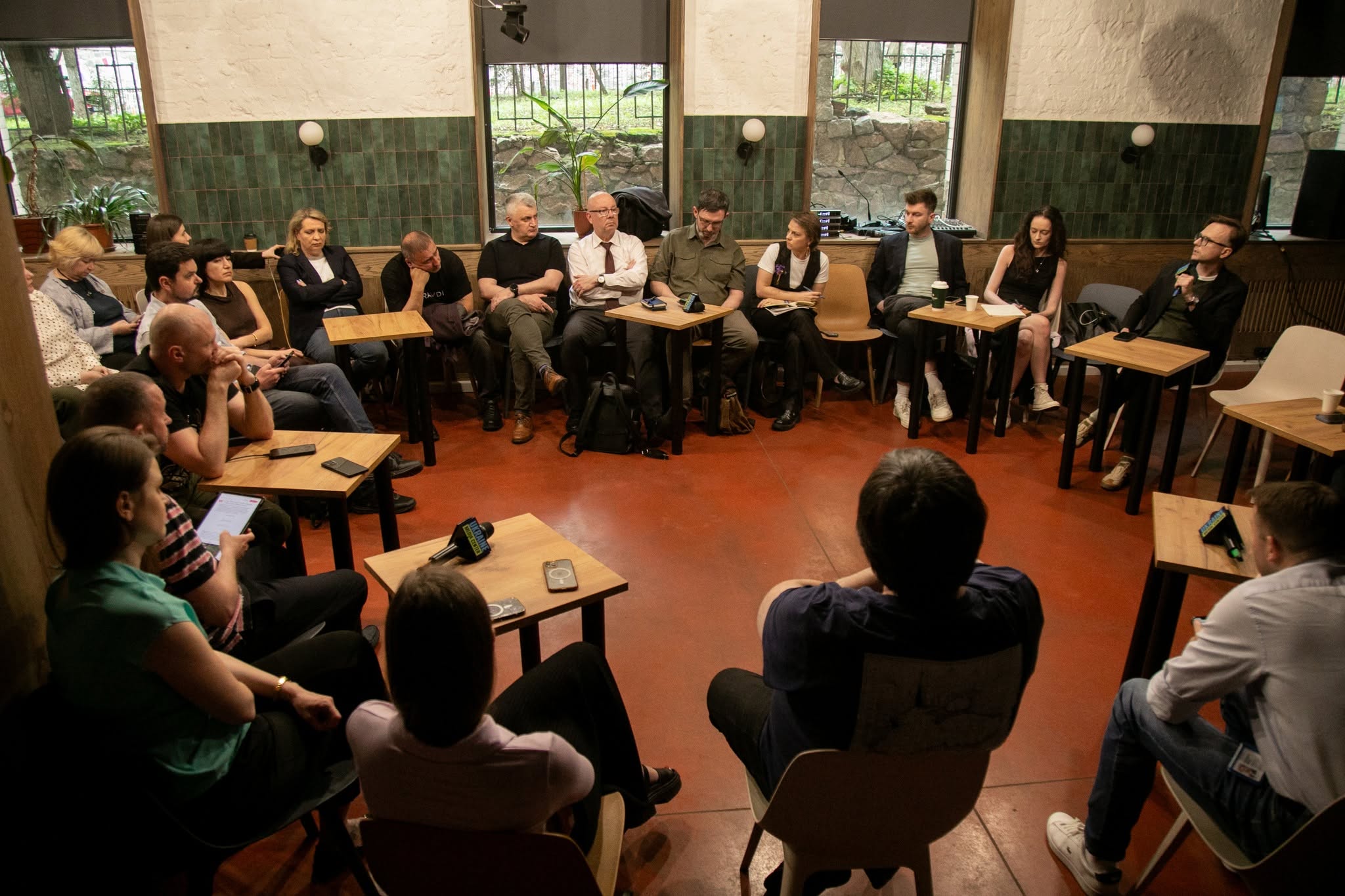
On June 9, a closed professional discussion took place in Kyiv focusing on the challenges Ukrainian newsrooms face during wartime. The event was organized by “Detector Media” and “Media Center Ukraine”. Held under the Chatham House Rule, the discussion brought together representatives of media organizations, the Ministry of Defence of Ukraine, the Defence Intelligence of Ukraine (HUR), the Armed Forces of Ukraine, bloggers, and experts. DII-Ukraine was represented by Head of the NGO Liubov Rakovytsia and Anna Murlykina, coordinator of the Relocated Media Cluster support project.
The discussion was prompted by several high-profile journalistic cases that have sparked intense debate within the professional community and wider society in recent months.
One of these cases was “The Kyiv Independent” investigation into the activities of the resistance movement “Yellow Ribbon”. The authors raised questions about whether sufficient attention had been paid to the safety of activists in temporarily occupied territories and whether certain operational practices may have created additional risks for people involved. The publication generated broad public discussion due to the complexity of the issue: on one hand, public interest and the need for journalistic scrutiny; on the other, risks to members of the resistance movement and broader questions about the limits of acceptable reporting during wartime.
Another case discussed was a report by “Realna Hazeta” on the aftermath of a strike in occupied Starobilsk. Journalists confirmed civilian casualties following the attack and published their findings. This triggered debate: some viewed such reporting as creating risks for the country’s information security, while others argued that honest documentation of the consequences of war — regardless of location — is part of journalists’ professional responsibility.
Participants also discussed public positions expressed by journalists serving in the military — including Dmytro Larin, Pavlo Kazarin, and Serhii Hnezdilov — regarding whether anti-corruption investigations should adapt their logic and approach during wartime.
Participants sought to answer difficult questions: where the line lies between public interest and national security, whether separate professional standards for media are needed during wartime, and how to avoid a situation in which editorial teams begin practicing self-censorship.
During the discussion, DII-Ukraine representative Anna Murlykina emphasized that even in the absence of a unified position, maintaining professional dialogue within the media community remains critically important.
“I agree with colleagues who said that, unfortunately, the media community is fragmented, and it is unlikely that we will be able to agree on common rules. But the absence of a community may cost us very dearly,” she noted.
The key takeaways from the discussion will later be published on the “Detector Media” website.
Photo: Media Center Ukraine