
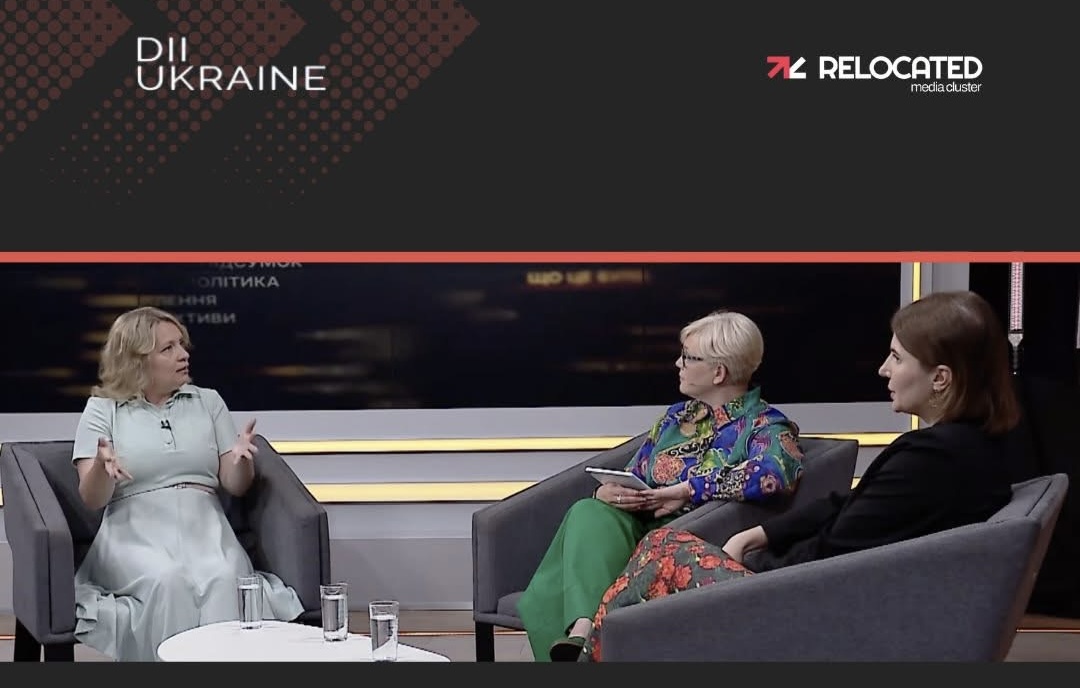
How to communicate with people living under occupation, whether Ukrainians in occupied territories are being mobilized into the Russian army, and how Russia is reshaping the cultural space in occupied areas — these topics were discussed during the “What Was That? ” program on Ukrainian Radio hosted by Tetiana Troshchynska.
The discussion featured journalist, founder and Editor-in-Chief of Mariupol-based media outlet “0629.com.ua”, and representative of DII-Ukraine, Anna Murlykina, alongside strategic communications and hybrid threats expert and Head of the NGO Join Ukraine, Liubov Tsybulska.
During the broadcast, participants discussed public sentiment in Russia amid mobilization, the situation in Ukraine’s temporarily occupied territories, and maintaining informational connections with people who remain on the other side of the front line.
Anna Murlykina highlighted the lack of clear state communication regarding the future of occupied territories and the people living there.
“Right now, we have one major blind spot — it is completely unclear what messages the Ukrainian state is communicating to people in the temporarily occupied territories. This is also connected to the fact that we still do not have a clear vision for the future of these territories — whether there will be a struggle for their return, whether a frozen scenario is being considered, and what prospects people have. As a result, there is a sense that almost no information reaches them,” Murlykina said.
She also shared an example from conversations with young people who had recently left occupied areas.
“We spoke with a young man who had recently left occupation. He said something very simple: his peers do not understand where to get information, what to do, or whom to turn to. Information does not reach them. There is very little of it. Sometimes young people genuinely feel that Ukraine has forgotten about them. They want to see messages addressed specifically to residents of the occupied territories — but those messages are not there. And this is a serious problem,” she said.
A separate part of the discussion focused on the mobilization of Ukrainians living in occupied territories into the Russian military. According to Murlykina, the situation differs depending on the region.
“While mobilization processes are already visible in Zaporizhzhia and Kherson regions, there is currently no mass mobilization in Donetsk and Luhansk regions. However, there are individual cases — students are being sent to the front, and people are being taken after being registered for military service. At the same time, authorities are actively searching for those whom Russia labels as AWOL — people who left the front after the forced mobilization campaign of 2022,” she explained.
Another topic of discussion was Russia’s systematic policy of Russifying children in occupied territories.
According to Anna Murlykina, Russia does not prohibit the word “Ukraine” itself, but consistently promotes the narrative that Ukrainian statehood and a distinct Ukrainian culture do not exist.
“Everything Ukrainian is reduced to a very narrow set of symbols — folk stereotypes, traditional dance, a few songs such as “Pidmanula-Pidvela” or “Rozpryahaite, Khloptsi, Koney”. In the Russian Federation’s narrative, no other Ukrainian culture exists. If before occupation it was a Ukrainian children’s ensemble — now it becomes a Russian ensemble. What is happening is a gradual recoding of children and of the cultural space,” the journalist said.
The full broadcast is available on Ukrainian Radio platforms and YouTube.